
If you want permanent hair removal for men, start by separating "long-term reduction" from true follicle-by-follicle removal. Laser is usually the practical first choice for large areas with dark, coarse hair, while electrolysis is better for light hairs, small zones, and precise cleanup. The best option depends less on the marketing claim and more on your hair colour, skin tone, treatment area, and how much regrowth you are willing to manage later.

Best permanent hair removal options for men
The two serious professional options are laser hair removal and electrolysis. They solve different problems, so choosing one for every body area is often the wrong way to think about it.
| Best fit | Method to consider first | What to expect |
|---|---|---|
| Large areas with dark, coarse hair | Laser | Fast coverage and strong long-term reduction, but possible maintenance |
| Small areas, light hairs, or exact shaping | Electrolysis | Slower appointments, but better precision and permanent treatment of individual follicles |
| Mixed results after laser | Laser first, electrolysis later | Efficient bulk reduction followed by targeted cleanup |
Best areas for male hair removal
The best treatment area is usually the one causing the most day-to-day annoyance: hard-to-shave back hair, heavy chest growth, neck bumps, or a beard line that never stays clean. Area choice affects cost, session time, method choice, and how realistic full clearance is.
Back and shoulders
Back and shoulders are classic laser areas because they are large, hard to shave evenly, and often covered with coarse hair. For a man who mainly wants to feel more comfortable at the beach, gym, or in summer clothing, strong reduction may be enough even if a little fine regrowth remains.
Electrolysis can still help later, but usually as a finishing step. Once laser has reduced the heavy growth, isolated patches or lighter hairs become much more practical to treat individually.
Chest and abdomen
Chest and abdomen treatments are not always about becoming completely hair-free. Many men want thinning rather than total removal, especially if they still want a natural look but less density under shirts or when trimming.
- Choose laser first if the hair is dark, thick, and spread across the area.
- Discuss the goal clearly if you want reduction rather than a fully smooth result.
- Expect possible touch-ups because chest and abdomen hair can be hormone-influenced.
Neck and beard line
The neck and beard line are often treated because shaving causes bumps, ingrown hairs, or irritation. Laser can reduce dark neck hair and make shaving easier, but electrolysis is better when the goal is a sharp permanent edge or removal of a small number of stray hairs.
What affects hair removal results for men
Your result depends on four things before anything else: hair colour, hair thickness, skin tone, and the area being treated. Hormones also matter, especially for the chest, abdomen, shoulders, and beard region.
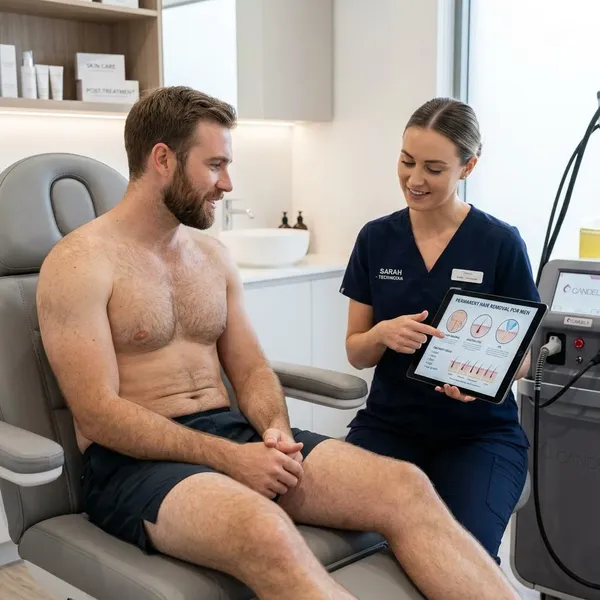
Hair colour and thickness
Dark, coarse hair usually responds best to laser because it contains more pigment for the laser to target. Fine or pale hair is harder for laser to "see," which is why some men notice the thickest hairs reduce first while softer lighter hairs remain.
If most of the hairs are blonde, red, grey, or white, do not spend money on laser without a very clear explanation from the clinic. Electrolysis is usually the safer bet for those hairs because it treats the follicle directly rather than depending on pigment contrast.
Skin tone and laser type
Skin tone affects both safety and device choice. Because laser energy interacts with pigment, the wrong settings or device can increase the chance of burns or pigment changes, especially on darker skin.
Darker skin is not automatically excluded from laser, but the clinic should be able to explain what device they use and why it suits your skin. Nd:YAG lasers are often used for darker skin tones, but the important point is not the name alone; it is whether the provider regularly treats skin like yours and adjusts settings carefully.
Hair density and treatment area
Dense hair takes longer because more follicles need to be treated across more growth cycles. A heavy back or chest may show progress early but still need patience before the result looks even.
For electrolysis, density has an even bigger impact. A few isolated neck hairs are realistic; a full dense back would usually be a long and expensive project if treated follicle by follicle from the start.
Hormonal regrowth
Male hair growth is often driven by androgens, so some areas can keep producing new or reactivated hairs over time. This is common around the beard, shoulders, chest, and abdomen.
Regrowth does not automatically mean the treatment failed. It may mean the area is hormonally active or that some follicles were not in the right stage during earlier sessions. For long-term planning, it is better to expect possible touch-ups than to believe a "one course and done forever" promise.
How many sessions do men usually need?
Men should expect repeat sessions with both laser and electrolysis. Hair grows in cycles, and a single appointment cannot catch every follicle at the ideal stage.
Exact numbers vary by clinic, body area, hair density, and method, so treat any estimate as a planning range rather than a guarantee. A moderate neck area is not the same commitment as a dense back, and a few beard-edge hairs are not the same as clearing a whole chest.
Laser takes multiple sessions
Laser sessions are usually spaced out because only some hairs are in the active growth stage at each visit. Early progress may look patchy: some areas thin quickly while others keep growing until later sessions catch more follicles.
- First sign of progress: slower regrowth or patchier coverage.
- Best response: dark, coarse hair with suitable laser settings.
- Reason to reassess: no visible change after several properly spaced sessions.
Electrolysis takes repeated appointments
Electrolysis needs repeated appointments because each visible follicle is treated individually, and not every hair is present at the same time. Even a small area can take multiple visits if the growth is dense.
The upside is control. For a man who only wants a few stubborn neck hairs or a clean beard edge handled permanently, the slower pace can be worth it because the work is targeted.
Dense areas can take longer
A dense back, shoulders, or chest will usually take longer than a narrow beard line. More hair means more follicles, more growth cycles, and more uneven stages of regrowth during treatment.
Regrowth may need follow-up treatment
Follow-up treatment is normal, especially after laser. It may be occasional maintenance on a few areas rather than a repeat of the full original course.
Electrolysis can permanently treat individual follicles, but missed follicles, newly active hairs, or hormonally influenced growth can still create new work later. The practical goal is often long-term control with far less grooming, not a fantasy of never seeing another hair again.
How to choose the right hair removal method
Choose by priority: area size first, then hair colour, then skin tone, then how exact the final result needs to be. That order prevents the most common mistake, which is choosing the method that sounds most permanent instead of the one that fits the job.
Choose laser for larger areas and dark hair
Laser is usually the best first step for dark, coarse hair on large areas such as the back, shoulders, chest, and abdomen. It gives the biggest visible change in the shortest practical time.
This is especially useful if your goal is less grooming rather than perfectly bare skin. For example, a man who shaves his shoulders every week may be happy with major thinning and occasional touch-ups, even if laser does not remove every fine hair.
Choose electrolysis for light or isolated hairs
Electrolysis is the stronger choice when the hair is light, the area is small, or the shape needs to be exact. It is not the fastest method, but speed is less important when you are dealing with a small number of hairs.
Use it for beard-line detail, pale hairs laser cannot target well, ear hair, or cleanup after laser has already reduced the main growth. Avoid choosing it for a large dense area unless you fully understand the time and cost commitment.
Combine methods for different treatment areas
Combining methods is often the most sensible plan for men with mixed needs. Laser can reduce the bulk on large dark-haired areas, and electrolysis can later handle the hairs that are too light, too scattered, or too close to a line that needs precision.
- Back first: laser for reduction, electrolysis only for leftover patches if needed.
- Beard line: laser for broader neck reduction, electrolysis for exact borders.
- Mixed hair colour: laser for dark hairs, electrolysis for pale remaining hairs.
Conclusion
The best choice is usually straightforward once you match the method to the job: laser for fast reduction on large dark-haired areas, electrolysis for light hairs and precise permanent cleanup. If you are treating more than one area, do not force one method to do everything; a mixed plan often gives the most practical result with fewer wasted sessions.


