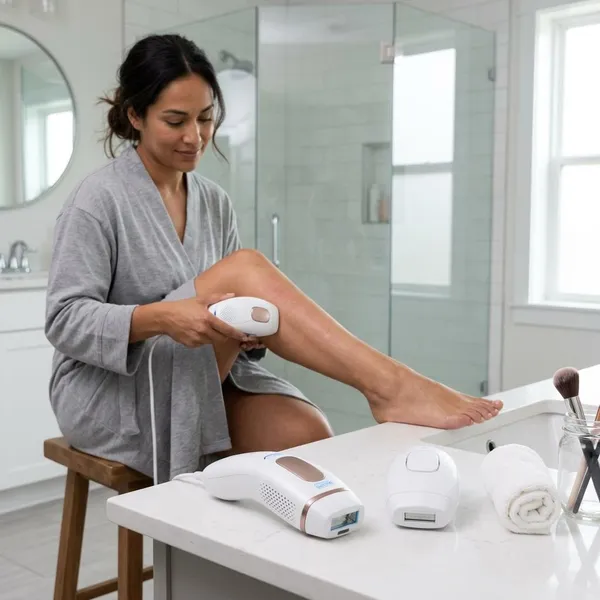
To decide how to determine skin tone for IPL hair removal, do not judge your complexion from memory. Match the exact area you want to treat against your device's official chart, on clean skin, in natural daylight, and treat any tan as part of your current skin tone. If the area is darker than the approved range, recently tanned, tattooed, or paired with very light hair, IPL may be unsafe or unlikely to work well.

How to determine your skin tone for IPL
Start with the treatment area itself, not your general skin type. Your legs, underarms, face, arms, and bikini line may sit in different places on the chart because of sun exposure, friction, hormones, or natural pigmentation.
Use your device's official skin tone chart
The official chart matters more than a generic Fitzpatrick scale image online. Home IPL devices are not all approved for the same range of skin tones, and one model's "safe" zone may not match another model's.
The Fitzpatrick skin type scale can still help as a rough reference because it describes how skin reacts to sun and pigment. But for actual treatment, the manual and brand chart should decide whether a tone is inside or outside the device's intended range.
Check clean skin in natural light
Compare the chart with bare skin near a window or in soft outdoor daylight. Bathroom lighting, warm lamps, camera filters, and screen brightness can make fair skin look deeper or olive skin look washed out.
This is especially easy to get wrong if you use tinted sunscreen, fake tan, body oil, or makeup. Remove anything that changes color or shine before judging the area.
Compare each treatment area separately
A safe match on your lower legs does not automatically mean your bikini line, face, or forearms are safe too. IPL reacts to the pigment in the exact area being flashed.
For example, someone may be within range on their winter legs but too tanned on their forearms after a beach holiday. Another person may have light underarms but deeper pigmentation around the bikini line. In both cases, the darker local reading should guide the decision.
Assess your current tone, including any tan
Your current shade is the one that counts. A natural tan increases surface pigment, which can reduce the safety margin even if your untanned skin is normally suitable.
Self-tanner deserves the same pause, although for a different reason. It can make the skin look darker on the chart and may leave residue on the surface. If your color has changed recently, wait until it has faded and reassess before using IPL.
Ask for guidance if the match is unclear
Borderline tones are not the place to guess. If your skin seems to fall between two chart shades, if you have olive or mixed tones, or if one area looks noticeably darker than the rest, contact the brand's support team or ask a dermatologist or trained clinic professional.
A patch test can be useful, but treat it as one safety check rather than permission to ignore the chart. It only shows how a small area reacts under those exact conditions.
Why does skin tone matter for IPL?
IPL uses light energy that is attracted to pigment. The aim is to heat pigment in the hair root, but pigment in the surrounding skin can also absorb some of that energy.
That is why the best match is usually enough contrast: skin within the device's approved range and naturally darker hair at the root. As skin gets darker or more tanned, more light may be absorbed by the skin surface instead of the hair follicle.
Skin pigment can absorb light energy
Melanin is present in both hair and skin. IPL works best when the hair contains enough pigment to be the main target, while the surrounding skin absorbs less energy.
This is why skin tone charts are safety tools, not cosmetic labels. Warm, cool, or neutral undertone is less important than how much visible pigment is in the area being treated.
More absorption can increase burn risk
When too much light is absorbed by the skin surface, heat can build where you do not want it. Possible reactions include strong redness, tenderness, blistering, burns, or later dark or pale marks.
Device limits vary by model
Some home IPL devices are designed only for lighter skin tones, while others include sensors or lower settings for selected deeper tones. Those features can help, but they do not make a device suitable for everyone.
Use the rules for the model in your hand. Do not borrow safety assumptions from a clinic laser, another IPL brand, or a review from someone whose skin "looks similar" online.
What else should you check before IPL?
Skin tone is the first gate, but it is not the only one. IPL also depends on hair color, recent tanning, pigmented marks, tattoos, and anything that makes your skin more sensitive to light.
Natural hair color
IPL targets pigment in the hair root, so dyed hair length does not tell you much. Check the natural color close to the skin.
Brown and black hair usually give the clearest target. Dark blonde may respond less predictably, while red, gray, white, and very pale blonde hair often contain too little suitable pigment for good results.
Recent tanning and self-tanner
If the area is tanned, the safer move is usually to wait and check again later. A tan narrows the contrast between skin and hair and may increase the amount of light absorbed by the skin.
This matters for seasonal users. Someone who treats comfortably through winter may need to pause during summer, after a sunny holiday, or while using gradual tanning lotion.
Tattoos and darker skin marks
Do not treat directly over tattoos. Tattoo ink can absorb IPL energy strongly, which may cause pain, burns, blistering, or visible damage to the skin and possibly the tattoo.
Be cautious around dark moles, large freckles, birthmarks, and post-inflammatory marks too. If a mark has changed shape, color, size, or texture, get medical advice before using a light-based device nearby.
Health and medication restrictions
Some medications and skin conditions can make IPL a bad idea even when your skin tone and hair color look suitable. Photosensitizing medicines, certain acne treatments, recent strong exfoliation, active eczema, infections, open cuts, or severe irritation should be checked before treatment.
If you are unsure, ask a healthcare professional rather than testing a full area. This is especially important if your skin has reacted badly to sunlight, lasers, or cosmetic treatments before.

Conclusion
The safest decision is to treat skin tone as a current, area-by-area check rather than a fixed label. If the area is clean, untanned, clearly inside your device's chart, and paired with suitable natural hair color, IPL may be worth considering; if the match is borderline, recently tanned, tattooed, or medically uncertain, waiting or asking for professional guidance is the better choice.