
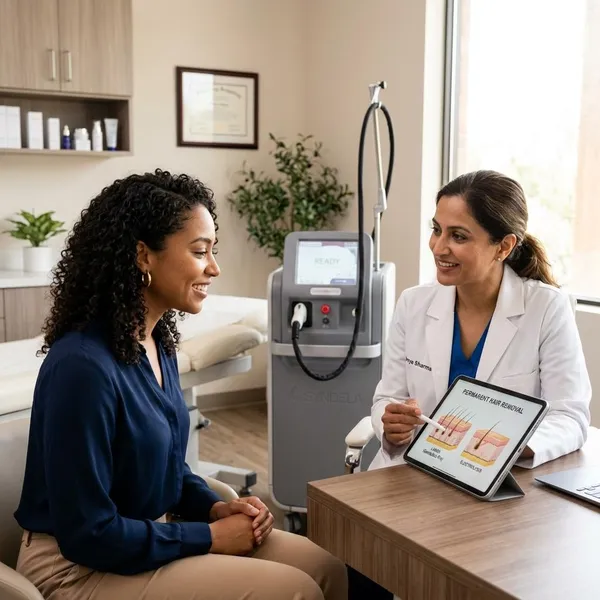
Permanent hair removal for brown skin is possible, but the safest choice depends on your skin tone, hair type, and how much risk you are willing to take with heat-based treatments. For larger areas with dark, coarse hair, a clinic Nd:YAG laser is often the most practical option; for small areas or hairs laser cannot target well, electrolysis is usually the better route.
Best hair removal options for brown skin
The first thing to decide is whether you want faster hair reduction over a large area, true permanent removal of individual treated hairs, or a lower-commitment home option. Those are not the same goal, and mixing them up is where many people choose the wrong method.
| Best fit | Option to consider | What to be careful about |
|---|---|---|
| Large areas with dark, coarse hair | Professional Nd:YAG laser | Device type, settings, cooling, and provider experience matter a lot. |
| Small areas, facial hairs, gray or fine hairs | Electrolysis | It is slower because each follicle is treated one by one. |
| Maintenance at home when your tone is approved | Compatible home IPL | Many devices are not suitable for deeper brown skin tones. |
Nd:YAG laser for long-term hair reduction
Nd:YAG laser is often the first clinic option to ask about for brown skin because the 1064 nm wavelength is less absorbed by surface melanin than many shorter wavelengths. That gives the provider more room to target the follicle without overheating the upper layers of skin.
It tends to work best where the hair is dark and coarse, such as underarms, bikini line, legs, chest, or back. Fine facial fuzz is a different story; it may respond poorly, and in some cases treatment can even make fine hair more noticeable. Most people need a series of sessions, with maintenance possible later, so it is better to think of laser as long-term reduction rather than a one-and-done permanent fix.
Electrolysis for permanent removal of treated hairs
Electrolysis is the option to look at when you want permanent removal of treated hairs, especially in small or detailed areas. It uses a fine probe to treat individual follicles, so it does not depend on the same skin-to-hair pigment contrast that laser does.
- Good for: chin hairs, upper lip, stray facial hairs, gray hairs, white hairs, red hairs, and laser-resistant fine hairs.
- Less practical for: full legs, full back, or other large areas unless you are prepared for many appointments.
- Main risk to manage: irritation, scabbing, or pigment changes from poor technique or weak aftercare.
If you have already reduced dense hair with laser but still have scattered stubborn hairs, electrolysis can be a useful finishing step.
Compatible home IPL for ongoing hair reduction
Home IPL can be tempting because it is private and convenient, but brown skin needs a stricter yes-or-no check before using it. If the device's skin tone chart does not clearly include your tone, do not try to "test it carefully" on a higher-risk area.
Home IPL is most realistic for someone whose skin tone is within the approved range, whose hair is dark enough to absorb light, and who is comfortable following a schedule for weeks or months. It is not the option I would choose for very deep brown skin, recently tanned skin, or anyone with a strong history of post-inflammatory hyperpigmentation unless a qualified professional has advised that the device is appropriate.
Why brown skin needs extra care with laser
Brown skin can be treated successfully, but there is less room for careless settings. The main issue is not whether laser works on melanin-rich skin; it is whether the energy is directed at the hair follicle without creating too much heat in the surrounding skin.
Your risk also changes by situation. Skin that tans easily, skin with old dark marks after acne or shaving bumps, and skin recently exposed to strong sun usually needs more caution than skin that has been stable and protected. A good consultation should treat those details as important, not as small talk.
More melanin can absorb treatment energy
Melanin absorbs light energy, and brown skin has more melanin in the surface layers. Laser hair removal works by using light energy to heat the hair follicle, but if too much of that energy is absorbed by the skin instead of the hair, the surface can overheat.
This is why wavelength matters. A device that is commonly used on lighter skin may not be the safest choice for deeper brown tones, even if the clinic says it treats "all skin types."
Wrong settings can increase burn risk
The machine is only part of the safety picture. Fluence, pulse duration, cooling, overlap, body area, and recent sun exposure can all change how the skin reacts.
A careful provider may start conservatively and increase only if your skin responds well. That should not feel disappointing; on brown skin, a measured approach is often safer than chasing the strongest setting from the first session.
Skin irritation can trigger pigment changes
Laser can cause hyperpigmentation when the skin becomes irritated, overheated, or inflamed. On brown skin, even a reaction that looks mild at first can sometimes leave a darker mark that takes time to fade.
- Avoid before and after treatment: tanning, harsh exfoliation, picking, waxing, and strong actives unless your provider says otherwise.
- Watch closely for: blistering, crusting, worsening tenderness, or color changes that do not settle as expected.
- Ask upfront: what normal redness should look like for your skin tone and when you should contact the clinic.
Provider experience affects treatment safety
Experience with brown skin is not a bonus; it is one of the main safety factors. A provider who regularly treats Fitzpatrick IV, V, or VI skin is more likely to understand conservative settings, patch testing, cooling, and pigment-risk aftercare.
Be cautious if the consultation feels rushed, if the clinic cannot name the laser they plan to use, or if they dismiss dark marks as "nothing to worry about." Confidence is helpful only when it comes with specific answers.
Why Nd:YAG is often used on brown skin
Nd:YAG is often used for brown skin because it offers a better balance between reaching the follicle and reducing surface melanin absorption. It is not automatically safe in every hand, but it is usually a more suitable professional laser choice for deeper complexions than wavelengths that interact more strongly with epidermal pigment.
This distinction matters when comparing clinics. "Laser hair removal" is too broad a phrase; you want to know the actual wavelength and whether the provider knows how to adjust treatment for your exact skin and hair pattern.
It is less absorbed by surface melanin
A true 1064 nm Nd:YAG wavelength is less attracted to melanin in the top layers of skin than shorter wavelengths. For brown skin, that can lower the chance of surface overheating when the treatment is planned well.
That does not remove the need for skill. Poor settings, poor cooling, or treating recently sun-exposed skin can still create problems, even with a suitable laser.
It reaches deeper hair follicles
Nd:YAG can penetrate deeper into the skin than some shorter-wavelength lasers, which helps when treating coarse terminal hairs. This is one reason it is often used for areas such as the bikini line, underarms, beard line, legs, chest, or back.
It can treat dark coarse hair effectively
Dark, coarse hair usually gives laser the best target because it contains more pigment and can transfer heat more effectively to the follicle. If your main concern is dense body hair, Nd:YAG may give a better balance of speed and practicality than electrolysis.
If your concern is fine facial hair, pale hairs, or a mix of hair colors, do not assume Nd:YAG will solve everything. That is where electrolysis may be the smarter long-term choice, even if it takes more patience.
How to choose a safe laser provider
For brown skin, choosing the provider is just as important as choosing the method. Before you book a full session, your priority should be: confirm the device, confirm experience with your skin tone, request a patch test, and understand the aftercare plan.
Ask about experience with brown skin
Ask directly how often they treat brown and darker skin tones. A useful answer will mention skin typing, pigment risk, patch testing, conservative settings, and how treatment may change by area.
For example, someone with dark underarm hair and no history of pigmentation issues may be a more straightforward laser candidate than someone treating facial hair after years of shaving bumps and dark marks. Both may be treatable, but they should not be handled with the same level of caution.
Confirm the laser used for your skin tone
Do not settle for "we have a laser that works for everyone." Ask which laser they would use on your skin tone and whether it is a true 1064 nm Nd:YAG.
If the clinic uses different devices, ask why they are choosing that one for you. If they cannot explain the choice in plain language, that is a reason to slow down before paying for a package.
Request a patch test
A patch test is a small trial spot done with the planned settings before treating a larger area. It is especially worth requesting if you are new to laser, have a history of hyperpigmentation, are treating the face or bikini area, or have recently had sun exposure.
Ask how long to watch the test area and what reaction would make them change the plan. The point is not to guarantee zero risk; it is to avoid exposing a large area before you know how your skin responds.
Discuss pigment risks and aftercare
Before treatment, ask what you should avoid and for how long. You should leave with clear instructions on sun protection, friction, shaving, workouts, heat, exfoliating acids, retinoids, and when to call if something looks wrong.
- Green flag: the provider explains normal healing for brown skin and gives written aftercare.
- Red flag: they promise no risk of burns or pigmentation.
- Practical rule: if your skin is irritated, freshly tanned, or already inflamed, it is usually better to delay than force the appointment.
Conclusion
The safest path is usually to match the method to the job: Nd:YAG laser for larger areas with dark coarse hair, electrolysis for small areas or hairs laser cannot treat well, and home IPL only when your skin tone is clearly approved by the device. If you are unsure, start with a consultation and patch test rather than a package deal, because protecting your skin tone matters more than rushing the first session.


