
If you are reading permanent facial hair removal reviews, the first thing to check is not the brand or the device—it is your hair color, hair thickness, and whether the growth is hormonal. Dark, coarse facial hair usually responds best to professional laser, light or gray hair is usually better suited to electrolysis, and at-home IPL is most useful for steady upkeep when your skin tone and hair color are compatible.
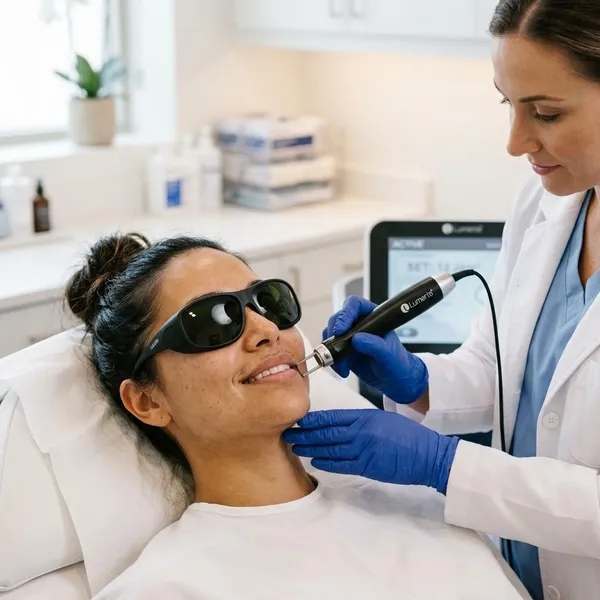
Laser facial hair removal reviews
Laser facial hair removal gets the strongest reviews from people with visible, dark facial hair they want to reduce quickly. It is less convincing for fine, pale, red, gray, or white hairs because laser depends on pigment to target the follicle.
Strong results on dark coarse hair
Dark, coarse facial hair is where laser usually makes the most sense. The hair has enough pigment for the light energy to target it, so people often notice less density, slower regrowth, and fewer rough stubble days after completing a proper treatment series.
This is also where laser can change daily habits the most. Someone who tweezes chin hairs every morning may not become completely hair-free forever, but needing far fewer touch-ups can still feel like a big result.
Faster treatment for larger facial areas
Laser is usually faster than electrolysis when the area is broad, such as sideburns, cheeks, jawline, or a dense chin patch. The appointment itself can be short, although the full plan still takes multiple sessions because hair grows in cycles.
- Good fit: dark hair spread across a visible facial area.
- Less ideal: only a few pale hairs, where treating each follicle directly may be smarter.
- Common mistake: judging the result after one session instead of waiting through the recommended course.
Maintenance is common with hormonal hair
Hormonal chin or jawline hair often needs a different expectation. Laser can reduce the hairs that are active now, but hormones may continue to trigger new growth later.
For someone with PCOS-related chin hair, laser may be best viewed as long-term control rather than a one-time cure. Reviews are usually more positive when people expect occasional touch-ups and, when appropriate, also speak with a medical professional about the underlying hormone pattern.
Patchy regrowth can happen
Patchy regrowth is not unusual on the face. Some follicles respond earlier than others, some are missed because of the growth cycle, and some hairs may be too fine to react well.
If only a few stubborn hairs remain after laser, electrolysis may be a better finishing method than buying more light-based treatments. That small switch is often more practical than trying to force one method to do everything.
At-home IPL facial hair removal reviews
At-home IPL reviews are most positive when people use the device for convenience and maintenance, not when they expect clinic-level removal from a few quick sessions. IPL uses broad-spectrum light and is generally weaker than professional systems, which is part of why it can be sold for home use but also why results build more slowly.
Easy to use for regular upkeep
IPL suits people who want privacy and a routine they can do at home. A small upper-lip or chin area may take only a short session, which makes it easier to stay consistent than booking repeated appointments.
It is a better match for mild upkeep than for heavy, hormonally driven facial hair. If you are already removing thick chin hair daily, a professional assessment may save more time than starting with a low-powered home device.
Results build with consistent use
IPL tends to show progress gradually: hair may return more slowly first, then feel softer or appear less dense. Skipping sessions is one of the main reasons people end up with weak results.
- Check compatibility first: your hair and skin must fit the device guidance.
- Patch test on the face: wait and watch for irritation before treating more skin.
- Follow the early schedule: consistency matters more than using a higher setting.
- Track changes every few weeks: daily checking makes slow progress hard to notice.
Darker hair responds best
Darker facial hair usually responds better to IPL because it absorbs more light. If your upper-lip or chin hair is dark but not extremely dense, an at-home device may help stretch the time between shaving, threading, or waxing.
Light facial hair responds poorly
Light blond, red, gray, white, and very fine facial hair usually responds poorly to IPL. If that describes your hair, a negative review may not mean the device is faulty; it may simply mean the method was wrong for the hair.
For pale scattered hairs, electrolysis is usually the more sensible place to spend money. It treats the follicle directly instead of relying on pigment.
Best facial hair removal method by hair type
The best method is easier to choose when you stop asking which treatment is "best" and ask which one matches your hair. Most bad experiences come from choosing a method that cannot realistically target the hair type.
Use this priority order before spending money: first check hair color, then thickness, then whether the growth is hormonal, then how much maintenance you are willing to do. Cost and pain matter too, but they should not come before basic suitability.
Dark coarse hair — laser
For dark, coarse facial hair, professional laser is usually the strongest first option. It treats multiple hairs at once and is often more efficient than electrolysis for a dense patch on the chin, jawline, sideburns, or upper lip.
Choose a provider carefully if you have deeper skin tone, sensitive skin, melasma-prone skin, or a history of pigmentation changes. The right device and settings matter more on the face than on less visible body areas.
Light or gray hair — electrolysis
Light, gray, white, and red facial hairs are usually better suited to electrolysis. It does not need dark pigment, so it can treat hairs that laser and IPL often ignore.
The trade-off is time. Electrolysis treats follicles one by one, so it is especially practical for scattered chin hairs, pale upper-lip hairs, or leftover hairs after laser—not necessarily for someone wanting quick coverage over a large dense area.
Hormonal chin hair — professional treatment
Hormonal chin hair is usually worth handling professionally, especially if it is dense, new, or getting worse. Laser may reduce dark hairs well, while electrolysis can clear lighter stubborn hairs that remain.
- If the hair is dark and coarse: start by asking about laser suitability.
- If the hair is mixed or pale: ask whether electrolysis would be more reliable.
- If growth is increasing quickly: consider medical advice as well as cosmetic treatment.
At-home upkeep — IPL
At-home IPL works best as upkeep for suitable dark hair, especially when the goal is fewer touch-ups rather than a permanent fix. It can make sense after professional laser or for mild facial hair that does not justify clinic visits.
Laser vs IPL vs electrolysis
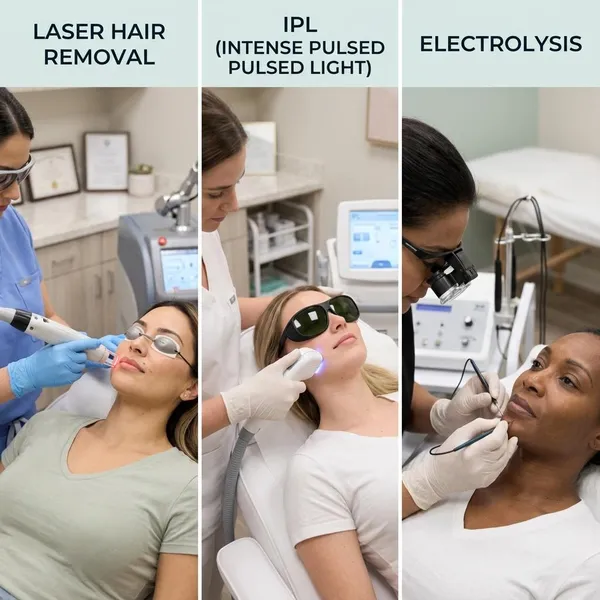
Laser, IPL, and electrolysis are often discussed together, but they are not interchangeable. Laser is usually the practical choice for faster reduction on dark hair, IPL is the convenience choice for compatible at-home upkeep, and electrolysis is the most reliable choice when true permanence or light hair treatment matters most.
Permanence
Electrolysis is generally the closest option to permanent removal because each follicle is treated directly. Laser is better described as long-term reduction, and IPL is usually best described as ongoing reduction or maintenance.
| Method | Most realistic expectation | Best use case |
|---|---|---|
| Laser | Long-term reduction, possible touch-ups | Dark, coarse facial hair |
| IPL | Gradual reduction with maintenance | At-home upkeep on suitable hair |
| Electrolysis | Most permanent follicle-by-follicle treatment | Light, gray, or stubborn facial hair |
Pain
Electrolysis is often described as the most uncomfortable because each follicle is treated separately. Laser can feel like a quick hot snap, while at-home IPL is often milder but also less powerful.
For the upper lip, even a "mild" method can feel sharp because the area is sensitive. If pain is a major concern, ask about cooling, numbing options, or starting with a small test area before committing.
Cost
At-home IPL has the clearest upfront purchase cost, but it is only good value if your hair type is suitable and you actually use it regularly. A cheap device that does little for pale hair is still wasted money.
Laser usually costs more per session but may be efficient for dark dense facial hair. Electrolysis can add up because it is slower, yet it may be the better investment for small numbers of light or stubborn hairs.
Treatment time
Laser is usually fastest per appointment for larger facial areas. IPL is quick at home but depends on repeated use. Electrolysis is slowest because it works hair by hair, though that is exactly why it can be so useful for precise cleanup.
Maintenance
IPL usually needs the most regular upkeep. Laser often needs occasional touch-ups, especially with hormonal growth. Electrolysis typically needs less long-term maintenance once the targeted follicles have been successfully treated, though new hairs can still appear over time.

Conclusion
The smartest choice is the one that matches the hair in front of you: laser for dark coarse facial hair, electrolysis for light or gray hairs, and IPL for convenient upkeep when your skin and hair are compatible. If hormones are involved or the hair pattern is changing, do not expect any device to be a simple one-time fix; getting the method matched correctly at the start is what prevents the most regret.


