
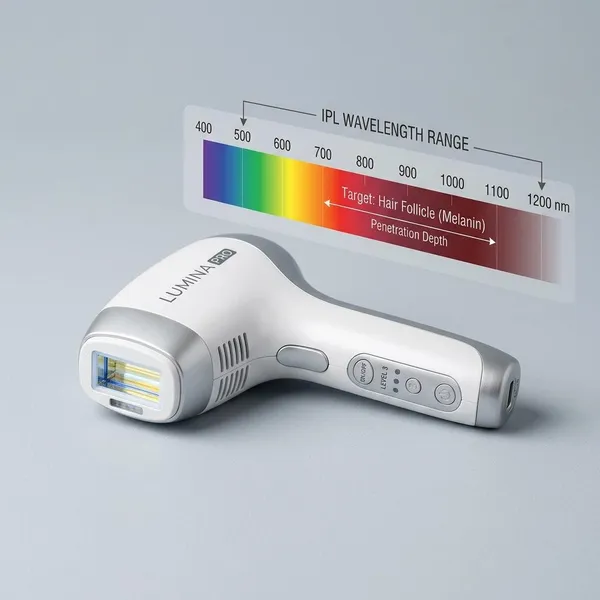
Most IPL hair removal devices are described as using a broad light range of about 500 to 1200 nm, but the useful part is usually narrower once filters are involved. If you are comparing devices, do not judge by the biggest wavelength range alone. First check the filtered treatment band, then match it to your skin tone, hair color, and whether you want easy home maintenance or a more controlled clinic treatment.
What is the IPL hair removal wavelength range?
The IPL hair removal wavelength range is the span of light wavelengths an IPL system can produce and deliver after filtering. Unlike a laser, which is built around one main wavelength, IPL sends out a band of light. That makes the numbers on product pages a little less straightforward than they look.
Many IPL systems span about 500 to 1200 nm
Many IPL systems are commonly described as spanning roughly 500 to 1200 nm, especially when they use xenon flash lamp technology. Treat that as a broad technical reference, not a promise that every wavelength in that range is doing equal work on the follicle.
For hair reduction, the lower end of the range can be more strongly absorbed near the skin surface, while longer wavelengths tend to travel deeper. That balance matters most if you have medium or deeper skin tone, sensitive skin, or coarse hair that sits deeper in the follicle.
Filters narrow the usable wavelength band
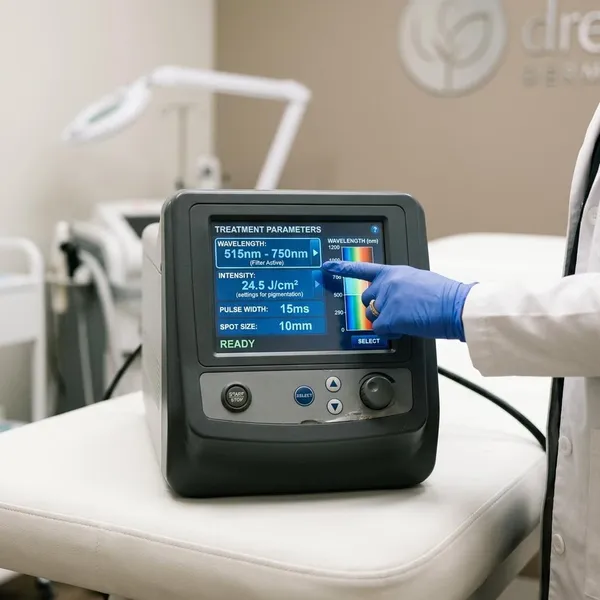
Filters are what turn a broad IPL flash into a more useful treatment band. A cutoff filter blocks light below a certain point, such as around 515, 550, or 590 nm, so the remaining wavelengths are better suited to the treatment goal.
- For fair skin with dark hair: a wider usable band may still work well because the hair-skin contrast is high.
- For medium or deeper skin tones: more selective filtering and conservative settings become more important.
- For fine, light, red, gray, or white hair: the wavelength range matters less if there is not enough melanin for the light to target.
The exact range varies by device
There is no single IPL range that every device must use. Clinic systems may offer interchangeable filters, stronger cooling, and more adjustable energy settings. Home devices are usually more limited on purpose, because they need to be safer and simpler for repeated self-use.
If you are buying a home IPL device for occasional leg maintenance before summer, comfort, skin-tone sensing, and a realistic schedule may matter more than the widest wavelength claim. If you have darker skin, stubborn regrowth, or a history of irritation, the safer choice is usually a professional consultation rather than guessing from a spec sheet.
Why does the IPL wavelength range vary?
The range varies because IPL is a category of light-based devices, not one fixed design. The lamp, filter, reflector, cooling system, pulse structure, and safety controls all shape the light that finally reaches your skin.
Lamp output differs by device
The lamp is the starting point. Most IPL systems use a flash lamp, often xenon-based, but lamp quality affects output strength, consistency, and how evenly the device performs over many flashes.
More lamp power is not automatically better. If the device does not control that light well, extra energy can mean more surface heat rather than better follicle targeting. For regular home use, a stable device you can tolerate every session is usually more valuable than a harsh device you stop using after two treatments.
Cutoff filters block unwanted wavelengths
A cutoff filter removes wavelengths below its cutoff point and lets longer wavelengths pass. For hair removal, this helps reduce unnecessary heating close to the skin surface and shifts more of the pulse toward wavelengths that can be more useful for follicle heating.
The filter is especially important when skin contains more melanin. It does not make every IPL device suitable for every skin tone, but it is one of the main reasons a cautious device can be safer and more comfortable than a poorly controlled one.
Device design shapes the final light spectrum
The final spectrum is shaped by more than the lamp and filter. A treatment window, reflector, pulse timing, cooling plate, and software limit can all change how the light behaves in real use.
When comparing devices, check these points before worrying about the largest wavelength number:
- Supported skin tones: look for a clear skin tone chart or sensor guidance.
- Suitable hair colors: dark hair is usually the best target; very light hair is a weak target.
- Filter information: a stated cutoff or treatment band is more useful than a vague "broad spectrum" claim.
- Comfort controls: cooling, contact sensors, and intensity steps affect whether you can use it consistently.
- Routine fit: large areas need a practical window size and a schedule you can actually follow.
How do IPL wavelengths target hair?
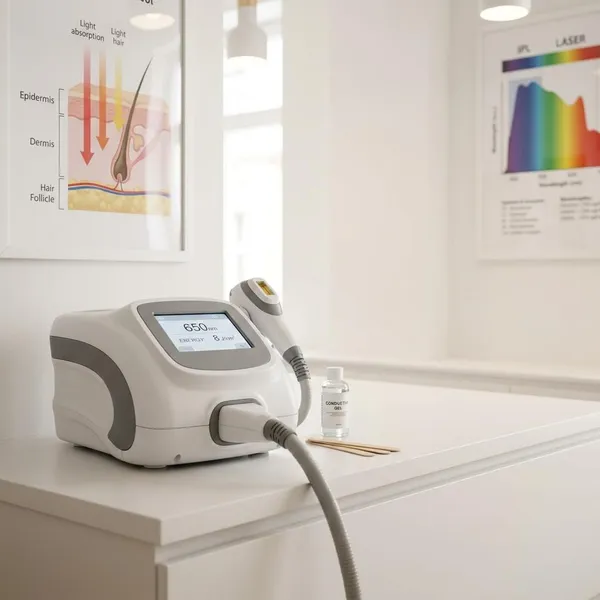
IPL targets hair through melanin, the pigment that gives dark hair its color. The light is absorbed by pigment in the hair, turns into heat, and can weaken the follicle when enough energy reaches it during the right growth phase.
Melanin absorbs light in the hair
Melanin is the main target for IPL hair reduction. Black and dark brown hair usually respond better because they contain more pigment. Blonde, red, gray, and white hair often respond poorly because there is less pigment to absorb the light.
Body area matters too. Underarms and bikini lines often respond sooner because the hair is commonly darker and thicker. Fine facial fuzz or sparse arm hair may need more patience and may never show the same level of reduction.
Longer wavelengths reach deeper into the skin
Longer wavelengths generally penetrate deeper than shorter wavelengths. That can help with thicker hair or deeper follicles, but depth alone does not guarantee better results. The light still needs enough melanin absorption to create useful heat.
Absorbed light turns into follicle-heating energy
The useful effect comes from heat in the follicle, not from the light number itself. That is why preparation and technique matter even when the device has a suitable wavelength band.
- Shave first: leave the root under the skin, but remove surface hair that can singe and waste energy.
- Patch test: use a small area first and wait as directed before treating more skin.
- Start conservatively: the highest setting is not always the smartest setting, especially on sensitive areas.
- Cover evenly: overlap too much and irritation can rise; leave gaps and results look patchy.
- Repeat on schedule: IPL works gradually because hairs are not all in the same growth phase at once.
IPL vs laser wavelengths
IPL and laser hair removal both use light, but they deliver it differently. IPL uses a filtered band of wavelengths. Lasers use one main wavelength chosen for a more specific balance of pigment absorption, depth, and skin safety.
IPL uses a broad wavelength band
IPL is useful when the treatment situation is relatively straightforward: darker hair, suitable skin tone, and a user who can follow a regular schedule. It is also popular for home maintenance because devices are widely available and built with lower, consumer-friendly settings.
The tradeoff is precision. If your skin tone is deeper, your hair is light, or your regrowth has been stubborn after home treatments, a laser consultation may give clearer options than trying another broad-band device.
Alexandrite laser uses 755 nm
Alexandrite lasers use 755 nm, a wavelength with strong melanin absorption. That can make it effective for lighter skin with dark hair, but it also means more caution is needed when there is more pigment in the surrounding skin.
Diode lasers commonly use about 800 to 810 nm
Diode lasers commonly use about 800 to 810 nm. This range is widely used because it offers a practical middle ground between melanin targeting and penetration depth. In clinics, diode systems may also allow adjustments in cooling, pulse duration, and spot size.
For someone with coarse, dark body hair who wants stronger professional treatment, diode laser is often part of the conversation. It is still not automatically the best choice for everyone, so skin type and provider experience matter.
Nd:YAG laser uses 1064 nm
Nd:YAG lasers use 1064 nm. This longer wavelength is less absorbed by surface melanin than shorter laser wavelengths, which is why it is commonly considered for darker skin tones in professional settings.
Its strength is safer depth, not maximum pigment absorption. For very fine hair, it may not be as satisfying as shorter wavelengths in ideal light-skin, dark-hair cases, but for higher-risk skin tones it can be the more sensible professional option.
Conclusion
The IPL hair removal wavelength range is worth understanding, but it should not be the only spec you use to choose a device. A filtered, well-controlled range that suits your skin tone, hair color, and routine is usually more meaningful than the widest number on a product page. If your case is simple, home IPL can be a practical long-term maintenance option; if your skin tone, hair color, or sensitivity makes treatment less predictable, professional laser advice is the safer place to start.


